
What Is a Turquoise Cabochon?
A cabochon ("cab") is a stone that's been shaped and polished with a smooth, domed top and a flat back instead of facets. Turquoise is almost always cut this way because its beauty is in its color and matrix, not sparkle. The flat back makes it easy to set in a silver bezel for rings, pendants, bracelets and bolo ties.
How Turquoise Cabs Are Weighed and Priced
Turquoise cabochons are usually sold by the carat. One carat equals 0.2 grams, so a 3.2-gram cab weighs 16 carats. Price per carat depends on the mine, color, matrix, hardness and whether the stone is natural or stabilized. Example: a 16-carat cab at $2 per carat costs $32.
Natural vs. Stabilized Turquoise
Natural turquoise has not been treated. Stabilized turquoise has been infused with a clear resin to harden it and protect it from absorbing oils and changing color. Stabilization is a common, accepted treatment that makes softer turquoise usable for jewelry — but it should always be disclosed. Reputable sellers tell you which one you're buying.
Always ask whether a turquoise cab is natural, stabilized, or reconstituted. Gallery TCR lists the treatment on every turquoise product.
Matrix Patterns
Matrix is the host rock that runs through turquoise. It can form fine lines, webs, blocks or patches between the blue turquoise, and its color varies by mine: brown, black, golden or red. Many buyers choose a cab based on its matrix pattern.
Number 8 (#8) Turquoise
Number 8 turquoise comes from Nevada and is famous for its bold matrix in brown, black and golden tones set against blue to blue-green turquoise. It's a favorite of silversmiths and collectors.
Choosing the Right Cab
- Pick a shape that fits your design: oval, teardrop, triangle and freeform are common
- Check the back — a flat, even back sets more securely
- Look at the dome — a medium dome is easiest to bezel-set
- Choose matrix you love, because every cab is one of a kind
- Make sure the treatment (natural or stabilized) is listed
Tips for Setting Turquoise Cabs
- Use a bezel cup or bezel wire fitted snugly to the stone's outline
- Add a thin cushion (like sawdust or a backing sheet) under softer stones
- Avoid heat directly on the stone while soldering — set the stone last
- Clean finished pieces with a soft dry cloth; keep turquoise away from oils, lotions and harsh cleaners
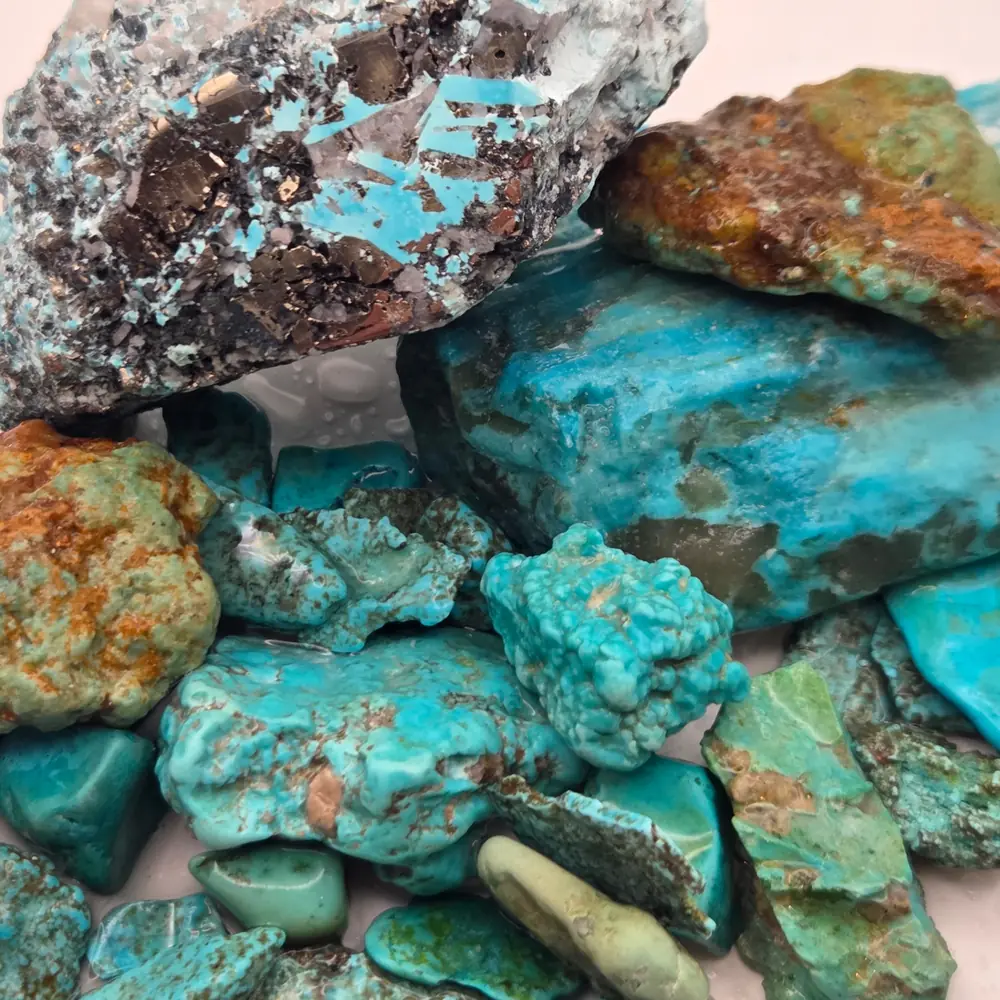
Looking for material to cut?
Looking for material to cut?
Frequently Asked Questions
How many carats is a gram?
One gram equals 5 carats, so 1 carat is 0.2 grams.
Is stabilized turquoise real turquoise?
Yes. It's real turquoise that has been infused with clear resin to make it harder and more stable. It must be disclosed, and it's priced lower than top natural turquoise.
Where does #8 turquoise come from?
Nevada, USA.
What size cab do I need for a ring?
Most ring stones are roughly 10–25 mm long; pendants and bolos can use larger cabs.